Tuesday, June 3, 2014

Week 8: Human Variation & Race

11.      High altitude has multiple effects on humans. The first issue being the constant climate changing from extreme heat and extreme cold. The more common issue though is the result of higher air pressure. This is due to the atmosphere being less dense in higher altitudes. The consequence of this is hypoxia, also known as oxygen deprivation. This occurs because the low air pressure makes it hard for oxygen to pass through humans selectively permeable lungs. This results of this start with being easily fatigued in physical activity, lack of appetite, vomiting, headache, distorted vision, fatigue, and difficulty thinking clearly.  Later it can result in severe hemorrhaging of the lungs and an abnormal accumulation of fluid around the brain. It also causes high blood pressure and pulse rate, causing stress to weaker hearts.

22.      Short Term: The short term response is the fatigue from physical activity. The reaction of being tired quickly alerts the person being affected to stop and rest until acclimatization can occur.
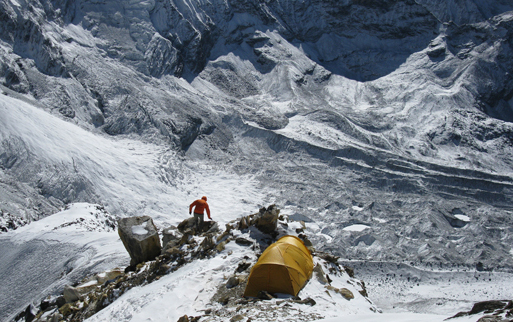
Facultative: The body will respond when acclimatization takes place. Acclimatization occurs when stresses such as high or low temperatures and intense ultraviolet radiation occur from sun light, or high altitude. The body will produce additional red blood cells and capillaries in order to carry more oxygen. Another occurrence is that the vascular network of muscles work increases better allowing for the transfer of gasses. These changes revert after a few weeks of remaining in low altitude.

Developmental Adaptation: One adaptation from thousands of years of natural selection is an increase in the production in hemoglobin. Hemoglobin is a gas transporting protein that exists within a red blood cell. It allows for increased amounts of oxygen to be carried in the blood.
 
Cultural Adaptation: One example of a cultural adaptation for high altitude is cabin pressurization in airplanes. In this process air is taken and greatly heated to compact it together, then it is cooled and expanded for the cabin, and effectively creates a high oxygen density in high altitude.

33.     Without understanding how and why environmental issue effect the human body there would be no way to create a solution. When human limitations are tested solutions can be designed. For example cabin pressurization would never have been designed if there was no knowledge of why hypoxia occurred for some and not others at higher altitude. It can be used to identify who is at risk for certain conditions, therefore preserving human life.


44.      To put it simply race has no influence on scientific findings. Race was an American concept that is irrelevant scientifically in any way. Environmental influences are what cause adaptation making it the relevant way to study human variation. Race groups people in way where adaptation patterns are missed because it has no impact on environmental location, which is where adaptation can be noticed. 

Tuesday, May 27, 2014

Week 7: Language Blog

Part 1: This was the easier of the two parts. While it was hard to keep a complex conversation going, because while my partner could convey complex concepts I could only respond in very simple terms. That forced my partner to do most of the talking. She found it very challenging to hold a conversation while trying to keep me involved as much as possible. She had to make complex questions have simple answers in order for me to communicate.
Clearly the people with a verbal language can convey the more complex ideas. To the that culture the ones who only spoke with gestures would be deemed inferior to the people with verbal language. it would also make people who spoke verbally not want to interact with the other culture. A group of people that would be in similar circumstances would be the deaf. While some could communicate with them using sign language most people do not know it resulting in the deaf having an extreme disadvantage. It is easy for the non deaf to communicate with those around them, but the deaf struggle to convey their intentions to people who do not speak sign language.

Part 2: This was the much harder part of the assignment. It is easy to not to talk, but to not be able to show body language made it hard to judge emotion. The only conversations that could be kept were ones of purely intellectual nature where emotion was not needed in order to explain fact, but unfortunately that did not last for the full 15 minutes. My partner was not able to get any real reaction out of me since I could not convey emotion.
Body language is extremely necessary to use body language in a conversation. Without it there is no way to show reaction and emotion without showing it. Conversation becomes bland and robotic and on top of that there is no sarcasm. How can I live without sarcasm? A group of people who may experience this would be the blind. While they still can hear alterations in tone and voice they are still at a huge disadvantage. Body language is necessary in order to know how to react to a person. If a person conveys sadness with their body it is often right response to reply with sympathy, but a person who could not see this, could not respond to it adequately. The only time that it is efficient to not show body language is when giving factual information.

Tuesday, May 13, 2014

Week 5: Piltdown Hoax Blog Post

The Piltdown man was a hoax in which British archaeologist Charles Dawson discovered  forged fossils that was made to look like the so call "missing link" between humans and apes. For years people believed the fossil to be legitimate and were hailed by the scientific community. With more modern dating methods scientists managed to prove the fossils to be fakes. There are many suspects in the case one of the more recent ones being Martin Hinton, who was found with the exact stain used to fake the fossils in his trunk.

Scientists did not catch this at the time of the discovery because modern dating technology did not exist to directly disprove it, and scientists thought other scientists to be gentlemanly scholars, not tricksters. The human mistake here was, too much trust out in others to accurately display findings. They needed to learn that others will lie for fame and they should always test others work.

Fluorine analysis, a relative dating method, led scientists to discover that the skull was older than the jaw.
The longer a bone lies in the earth the more fluorine it collects. Bones in the ground at the same location for the same amount of time should have the same amount of fluorine. The results clearly showed the age difference between the skull and jaw leading scientists to discover the skull to be human and the jaw to be that of an orangutan.

It is never possible to remove this human factor from science. People will always make mistakes, and people are required to make any form of scientific discovery. They must make the hypothesis, and therefore can always make mistakes. It would be more efficient to remove human error if it were possible, but it would take away much of the curiosity that makes humanity great.

The lesson learned here is to research findings past a single source. If someone can prove something through a procedure than others can replicate the result. Make sure sources are verified by something other than itself.

Thursday, May 1, 2014

Analogy/Homology

A homology that exists between humans and dolphins is the structure of the human arm and the dolphin fin. They have very similar bone structures each with five phalanges. Both species also have an ulna, radius, carpals and humerus. It is clear that the dolphin bone structure is much more condensed than the human arm, because of the fins design for forward movement. The Pakicetus is the most likely common ancestor. While it did not have arms it contained five phalanges in the leg similar to arm and fin structure today.
A good example of an analogous trait would be the fins of a fish and penguin.  The fins are used to propel through water, but one is a fish and the other a bird. While there are similar bones such as the humerus, radius, and ulna makes it is clear they developed differently by looking at the bone structure. Even with the similarities the structures formed independently due to environment. I could not find an exact common ancestor, but it must have been a teleostomi species. 

Thursday, April 17, 2014

Week 1 Post: Jean-Baptiste Lamark

1. Jean-Baptiste Lamarck had the most influence over Darwin. Lamarack was incredibly close to creating the idea of evolution. He noted that species changed according to how their environment changed, which is essential to Evolution. His theory of inheritance of acquired characteristics was taught to Darwin in schooling and gave him the basis for his work. The only thing Lamarck missed was genetic information, which was what Darwin needed to pick up on.

2. Lamarck claimed that life changes through a natural process instead of a divine power. He also claimed that organism adapt to their environment forcing organism to increase in complexity from their early simple forms.

3. If the environment changes, the traits that are helpful or adaptive to that environment will be different. This was the main idea Lamarck discovered. He came up with idea that species adapted to their environment

4. It is possible but not probable. The basis of Evolution is the fact that species change to adapt to their environment. This essential fact is what Evolution revolves around, and while Lamarck could not figure out the genetics portion of Evolution he put Darwin in the right direction.

            5.The attitude of the church definitely affected Darwin. The church, at the time, never has good initial             interactions with ideas that disagreed with basic principles of the church. Previous thinkers have been             killed, exiled, and arrested for speaking revolutionary thoughts. Darwin must have had to word his book       in a way to minimally upset the church.